
Book a consultation
Book a Family Mediation Consultation
Pick up the telephone, say what is on your mind and find out what mediation could look like for your family.
- One callto begin
- No pressureto continue
- Your decisionsat every stage
Why a First Conversation Matters

Before anything else, it helps to talk. A consultation is a short, unhurried conversation in which you explain what is happening and we explain what mediation could and could not do about it.
Starting is often the hardest part. Many people put off the call for weeks because they are unsure whether their situation is serious enough, complicated enough or calm enough. None of those worries is a reason to wait. You do not need to have your thoughts in order, your documents ready or the other person's agreement. A first conversation is a place to think aloud.
Booking a consultation with Family Mediator is a telephone enquiry. There is no online scheduler, no payment form and no booking confirmation on this website. You simply call 0330 010 0028 and speak to someone about your circumstances. That deliberate simplicity is meant to keep the first step human and low-pressure.
This page walks through everything that comes before and after that call, so that nothing about the process feels like a surprise.
Things Worth Thinking About Before You Phone
You can call without any preparation at all. If you would like to feel steadier, a few minutes of reflection beforehand can make the conversation more useful. None of the points below is a test; they are simply prompts.
- The headline. What is the main reason you are thinking about mediation? A sentence or two is plenty.
- The people involved. Who else is affected by the decisions, including children, and how do you expect the other person to feel about mediation?
- The most pressing question. Is there one decision that feels more urgent than the rest, such as living arrangements, money or contact with children?
- What you hope for. This might be a specific outcome, or simply calmer conversations with less conflict.
- Any worries. Concerns about safety, communication or the other person's willingness to take part are important, and it is better to mention them early.
- Your circumstances. Anything that would make taking part easier, such as particular times of day, a need to avoid face-to-face contact, or support for accessibility.
If you prefer to jot your thoughts on paper, keep the notes brief. A few words next to each point is enough to keep you on track without turning the call into a performance.
The Call Itself
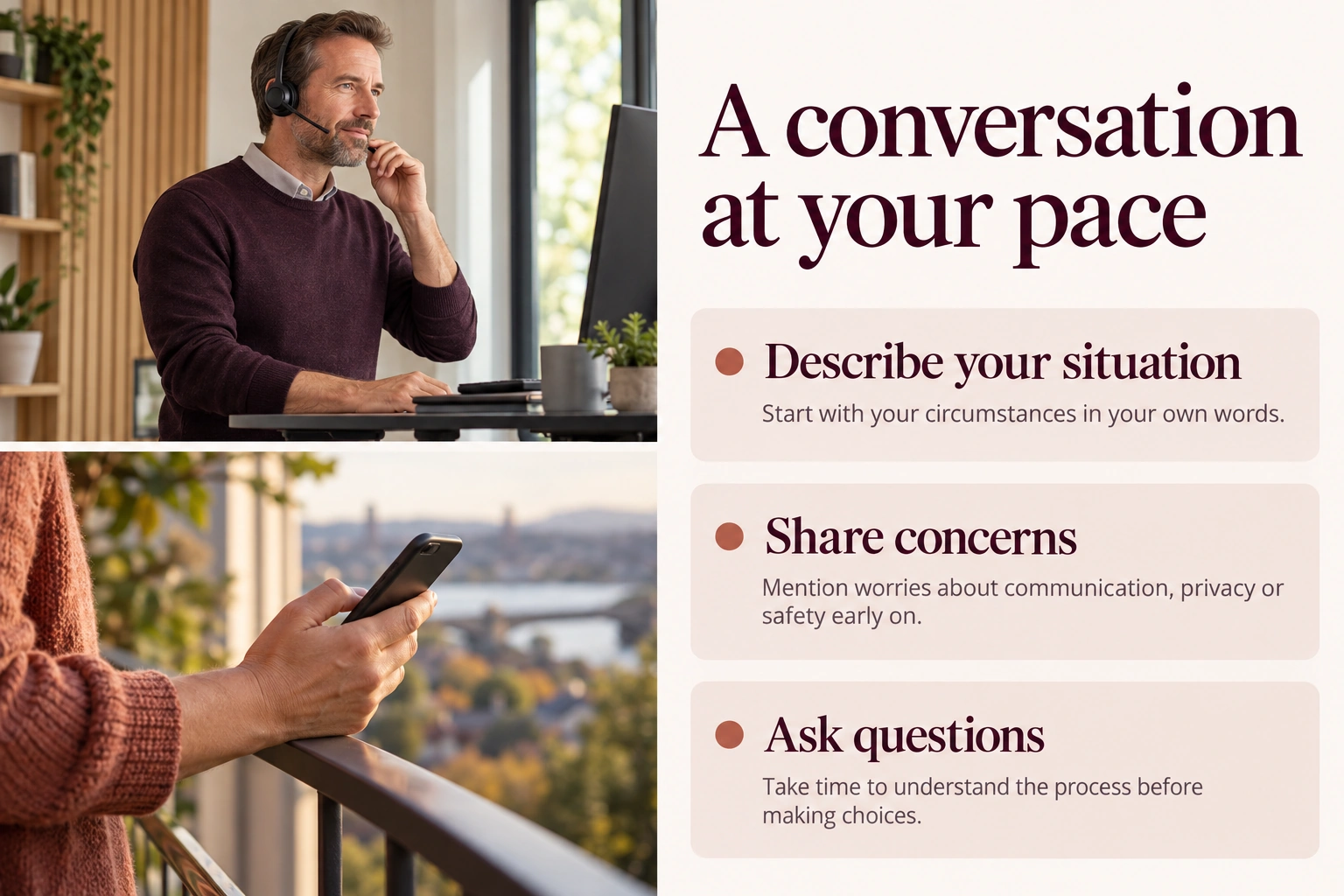
When you call 0330 010 0028, you will be speaking to a person who understands that you may be anxious, upset or unsure what to say. You do not need to explain everything. The conversation tends to follow your lead.
The purpose of the call is threefold. First, we want to understand your situation well enough to say whether mediation seems a sensible option. Second, we want to explain how the process works in plain language, so you can decide whether it suits you. Third, we want to talk through what could happen next, if you choose to go further.
You are free to ask anything. People often ask how mediation differs from going to court, whether the other person will have to attend, how long things usually take, and what happens if they cannot agree. Honest answers are given, including when the honest answer is that it depends or that nobody can promise a particular result.
You can end the call whenever you like. If you need time to think, to speak with a family member or to take advice, that is entirely reasonable. Nothing in a first conversation commits you to anything.
The only way to enquire through this website is by telephone. We do not run an online booking form, and we ask you not to send sensitive information through other channels.
Common Worries Before Calling
Almost everyone who calls has a worry or two. Naming them can take away some of their weight.
“My situation is too complicated.”
Complicated situations are exactly where a calm structure helps. You do not have to explain everything at once.
“I will be judged.”
A first conversation is about understanding, not assessing your character. Nobody is there to criticise how you got here.
“I will have to commit.”
A call commits you to nothing. You can take time, think, take advice and decide later.
“The other person will never agree.”
Hesitation at the start is common. We can talk about how to approach the invitation gently.
“I do not know the right words.”
There are none. Describe what is happening in your own way.
“I will get upset.”
That is understandable and perfectly acceptable. We can pause, and you can call back.
What We May Ask You
To make the conversation useful, we may ask a few simple questions. They are meant to help us understand where you are, not to judge or to build a case.
About the situation
We may ask what has changed in your family, whether you have already started talking about arrangements, and which topics feel most pressing. We might ask whether there are children involved and roughly how old they are, because this affects how we think about the discussion.
About communication
It is helpful to know how you and the other person currently talk to one another. Some people communicate reasonably well but cannot agree; others find that any contact leads to conflict. This helps us think about which format of mediation could work best.
About safety and comfort
We will ask whether there are any concerns about safety or about feeling pressured. These questions are asked of everyone, and your answers help us decide what is appropriate. If you would rather not answer something, tell us. Your wellbeing matters more than a complete set of answers.
About practicalities
We may check how you would prefer to take part, for instance by telephone or video, and whether there is anything that would make participation easier. We will not ask you for payment details or for sensitive documents during the first call.
What Happens After the Call
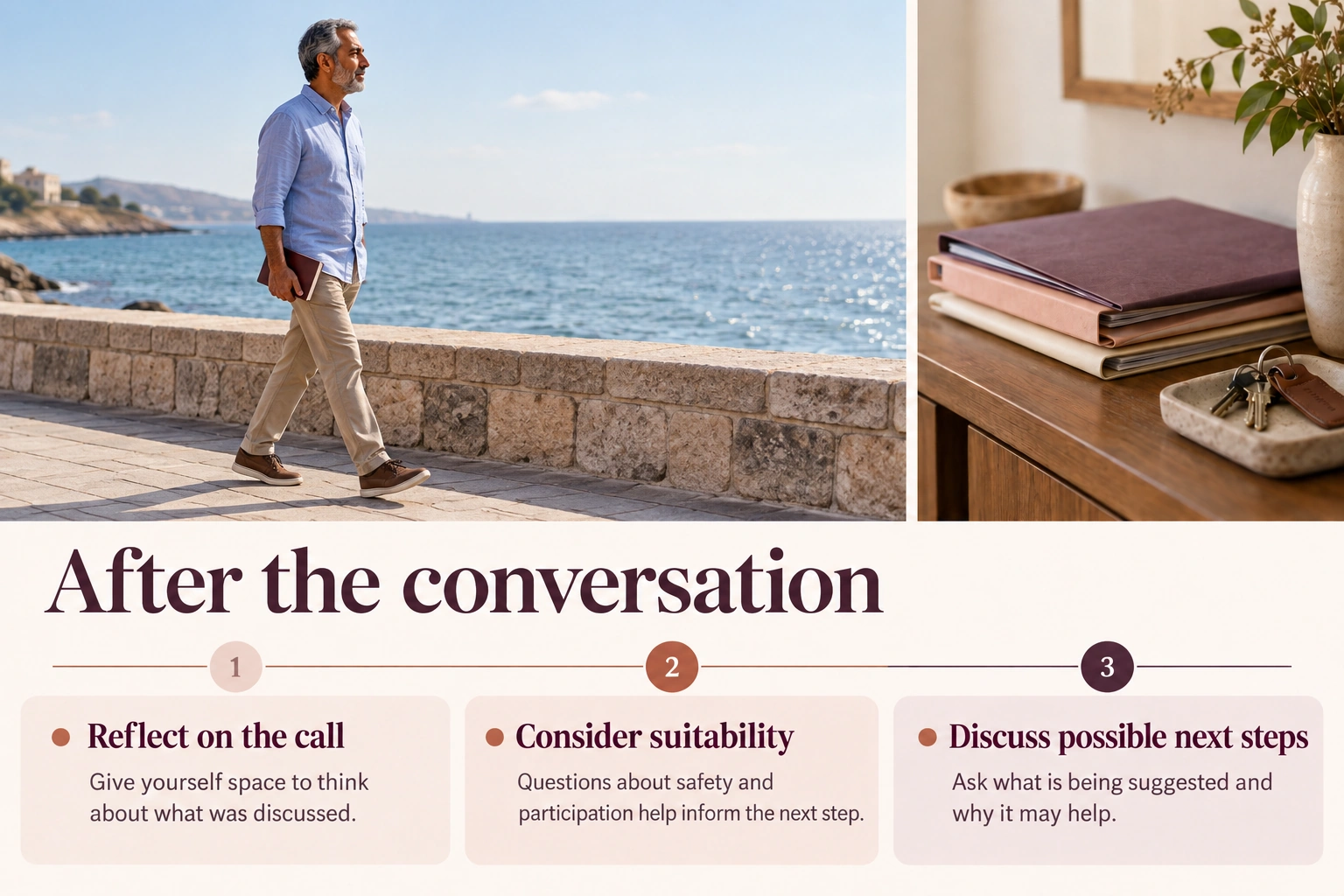
The next steps depend on what you decide. Some people take time to reflect before doing anything else. Others feel ready to move forward. Either is fine. If you choose to continue, the process usually follows a sequence like the one below.
You decide how to proceed
After the call you have time to think. You might want to speak with a trusted friend or an adviser, or you may already feel clear.
An information and assessment meeting
If mediation looks suitable, you are invited to a meeting to explore the process in more detail and to check that it is appropriate for your circumstances. Each person is usually seen separately at this stage.
Inviting the other person
Mediation involves two people, so the other person is invited to take part. We can talk with you about how best to approach this. They decide for themselves whether to join.
Planning the sessions
If both of you wish to proceed, you agree the practical arrangements, including the format and the topics to address first.
Starting the discussions
Sessions begin with your agenda, your pace and a mediator who keeps the conversation fair.
At each stage you remain in control of whether to continue. Nothing happens without your agreement.
Choosing How You Would Like to Take Part
Part of the first conversation is thinking about the format that would suit you. There is no single right answer, and the arrangement can be changed if it is not working.
Some people prefer to take part in a joint conversation, because it allows ideas to be explored in real time. Others find it easier to take part online or by telephone, from a place where they feel at ease and without a journey. Where being in the same conversation feels too much, the mediator can speak to each of you separately and carry information between you carefully and neutrally.
Questions that may help you decide include these. How do you and the other person currently communicate? Would you feel able to speak openly if the other person were present? Is there any reason that you would prefer not to be in the same room or on the same call? Do you need arrangements that fit around work, caring duties or other commitments?
Be as honest as you can about what would help. Nobody will think you are being difficult. An arrangement that feels safe and workable gives the process the best chance of being useful.
Bring Your Questions
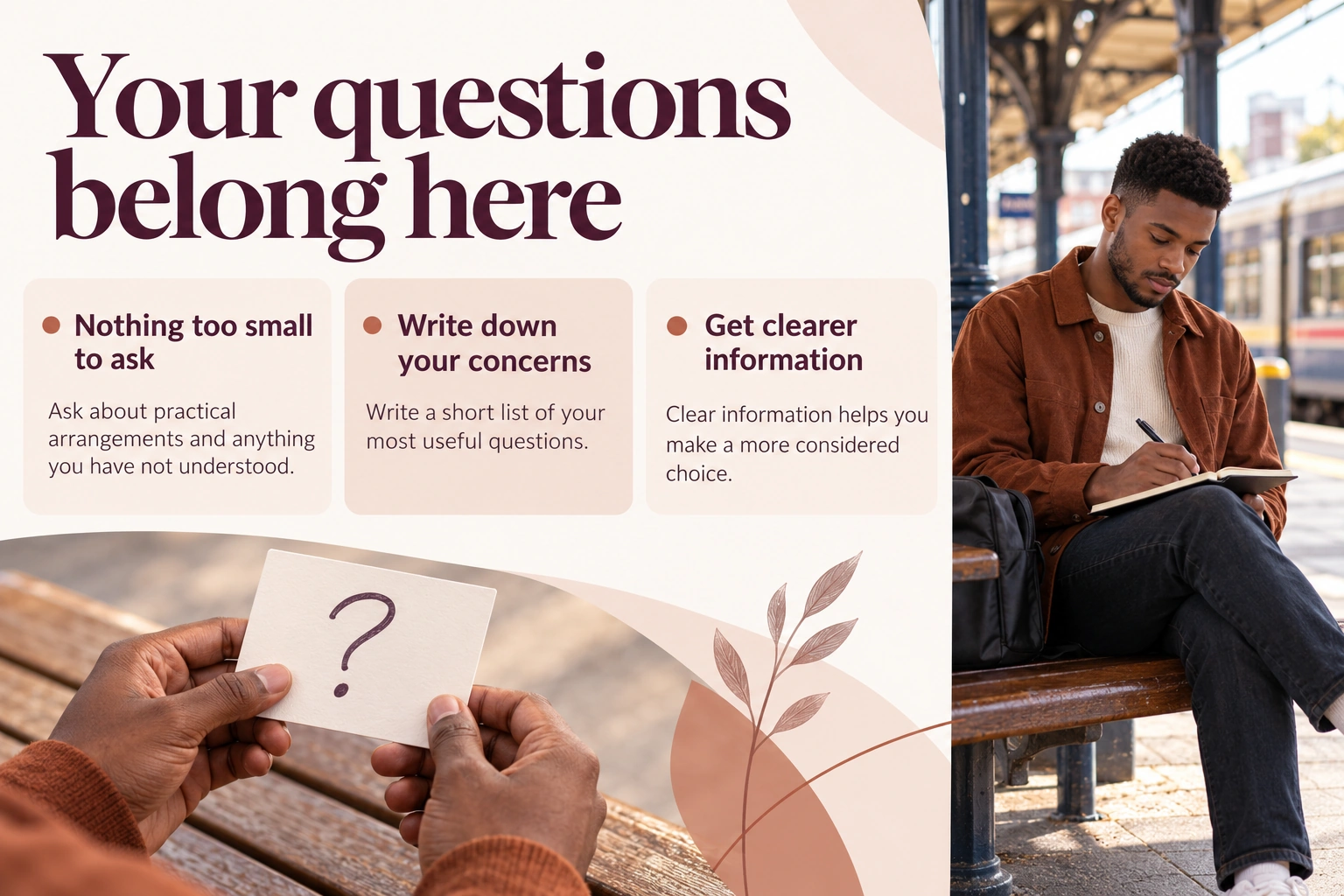
People often feel they should know the right questions before they call. There is no such thing. If it is on your mind, it is worth asking. Here are some that others have found useful, grouped by theme.
About the process
- How does mediation actually work from start to finish?
- How many meetings might be needed, and who decides?
- What happens if we reach an agreement, and what happens if we do not?
About the other person
- How is the other person invited, and what if they refuse?
- Can we take part without being in the same room?
- What happens if we find the discussions too difficult?
About children and money
- Can both children's arrangements and financial matters be discussed?
- Is it possible to begin with just one topic?
- How do advisers fit in alongside mediation?
About you
- I am nervous. Is that all right?
- I am not sure I want mediation. Can I still ask about it?
- What if I need to stop part-way through?
Write down anything else that occurs to you. A short list on the table beside you makes the call feel calmer.
Imagining the First Few Weeks
It can help to picture how things might unfold. The following is a general illustration, not a promise, because every family moves at its own pace.
You make the telephone call, and have a conversation lasting a while. You come away with a clearer sense of what mediation is and perhaps a few new questions. Over the next days you think things through, perhaps talking with a friend or an adviser. You decide that you would like to go further.
You attend an information and assessment meeting, where you talk through your circumstances in more detail and learn about the process. At the same time, the other person is invited to take part. Some people respond quickly; others need time. You may spend a little while waiting, which can be uncomfortable, but it is a normal part of the process.
If both of you are willing, you plan the first joint session. You agree on the format, and on what you would like to talk about first. You arrive with a notebook and some nerves. The mediator opens by explaining how the session will run, and then the conversation begins.
By the end of the first session you may not have decided anything important. You may, however, have heard something you had not heard before, and have a plan for what to think about next. That is often how progress begins.
The Information and Assessment Meeting
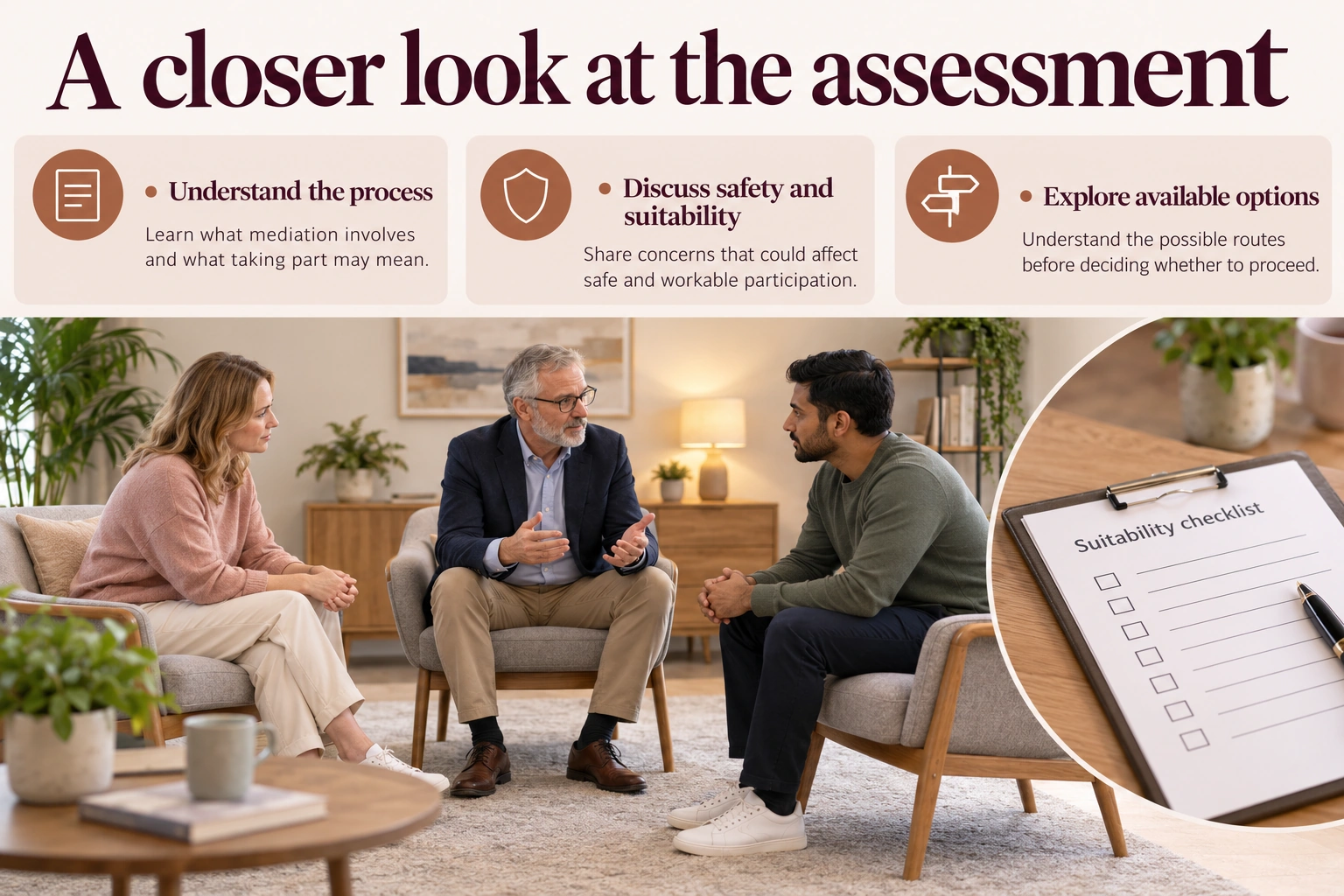
A Mediation Information and Assessment Meeting, often shortened to MIAM, is a more detailed first meeting that follows the initial telephone conversation. It is commonly the stage at which people decide whether mediation is right for them.
During the meeting the mediator explains how mediation works, what to expect of the sessions, and how it differs from other ways of resolving family matters. They listen to your account of the situation and ask about the issues you would like to address. They also consider whether mediation is suitable, taking into account safety, willingness to take part and the nature of the topics.
For many people, a MIAM is the first time that someone has calmly explained their options without pushing them in any direction. It is a chance to ask follow-up questions, to hear what other families commonly find helpful and to get a realistic sense of what mediation could do for you.
Where court applications about children or finances are being considered, attending a MIAM may be expected before an application can be made, subject to certain exceptions. It is wise to take independent legal advice about your specific situation, because the rules depend on individual circumstances.
After the meeting, you decide whether to go ahead. If you choose to proceed, the other person is invited to attend their own meeting, and joint sessions are then planned if both are willing.
If the Other Person Is Unsure
One of the biggest worries people have is that the other person will not agree to take part. It is a fair concern, and it is more common than you might expect for a first reaction to be hesitant or defensive.
Mediation depends on both people being willing, so we do not pressure anyone. What we can do is explain the process clearly, so that the invitation does not feel like a threat. Often, reluctance comes from misunderstanding. Some people assume that mediation means giving in, that it will be a means of assigning blame or that the mediator will be on the other person's side. A clear and neutral explanation can ease these fears.
It can help to think about how you introduce the idea. Presenting mediation as a chance to be heard, rather than an ultimatum, tends to be better received. Choosing a calm moment, keeping the message short and emphasising that nothing is being decided in advance can all make a difference. We are glad to talk through ways of approaching this.
If the other person still declines, that is their right. You can then consider what other support might be available, and you may find that a conversation with a mediator has still helped you clarify what you want.
Looking After Yourself Along the Way
Family change is tiring. Even when you are doing the right thing, it can leave you drained, tearful or unusually irritable. Taking care of yourself is not a distraction from the process; it is part of what makes good decisions possible.
- Keep routines where you can. Regular meals, sleep and movement help more than they appear to.
- Choose your confidants. Talk to people who listen well and do not inflame the situation.
- Give yourself breathing space around sessions. A short walk or a quiet cup of tea before and after can help.
- Do not make big decisions in the heat of the moment. It is fine to say you will think about it.
- Seek additional support if you need it. Talking to a counsellor, doctor or support organisation is a sign of good sense.
If you ever feel overwhelmed during the process, say so. Pauses and adjustments are always possible.
Children and the Consultation
If you have children, you may wonder when and how to involve them. Children are not asked to attend a consultation, and mediators do not expect you to explain every detail to them in advance.
What children generally need is honesty, reassurance and consistency. They need to know that they are loved, that the changes are not their fault and that important adults are working things out. The way parents speak about one another in front of children matters a great deal, even when feelings are raw.
If you are unsure how to talk to your children about what is happening, you can raise this in your first conversation. Mediation can help parents agree on how to share information, so that children hear consistent and age-appropriate messages.
As arrangements are being worked out, the focus is on what will make ordinary life feel steady for them: routines, relationships, school and the sense that both parents remain part of their lives.
Making the Call Easier on the Day
Choose a time when you are unlikely to be disturbed and when you are not already exhausted. Many people find that mid-morning or early evening suits them better than the end of a stressful day, although the best time is whichever feels right to you.
If you share your home with the other person or with children, think about where you can speak freely. A parked car, a quiet room or a walk outdoors can all work. Switch off other distractions, and keep your phone charged so that the conversation is not cut off.
Finally, give yourself a few minutes afterwards. You may feel relieved, or emotional, or simply tired. Taking a moment before returning to your day is kind to yourself, and gives your thoughts time to settle.
Safety, Suitability and Honest Answers
Not every situation is right for mediation, and we would rather say so than carry on. The most important consideration is safety. If you or anyone in your family may be at risk, that must come before any discussion of arrangements.
We ask about safety because mediation depends on both people being able to speak freely, without fear. Where there are concerns, we consider whether adjustments could make the process safe and fair, such as separate sessions, or whether a different route would better protect you. This is decided carefully, with your wellbeing in mind.
Other factors also affect suitability. Both people need to be willing to participate, to listen and to consider each other's views. Each needs to be able to understand the process and to make their own decisions. Situations involving significant imbalance or pressure may need additional support before mediation is workable.
If you are in immediate danger, contact the emergency services. Telling us about difficult experiences is never a reason to feel embarrassed, and we will not ask you to explain more than you wish to.
People Who Can Support You

Going through a family change can feel isolating, but you do not have to carry it alone. Many people find it helpful to think about who is in their corner before beginning mediation.
Friends and relatives can offer comfort and practical help, although they may not always be objective. Independent legal and financial advisers can explain your position and options in detail. Counsellors and therapists can support you with the emotional side of things. For children, trusted adults such as grandparents, teachers or family friends may offer a steady presence at a time of change.
Mediation sits alongside these sources of support rather than replacing them. A mediator will not tell you who to turn to, but can help you recognise when additional support might be useful and encourage you to seek it. If you have a person you would like to talk through your options with before or after sessions, that is entirely sensible.
Useful Things to Gather Over Time
You do not need any paperwork for the first conversation. If mediation goes ahead, particularly on financial matters, it helps to have certain information to hand. You can collect this gradually and at your own pace.
- A rough list of regular income and household outgoings.
- Details of savings, debts and any significant assets, such as property or pensions.
- Information about children's schools, activities and routines.
- Any existing agreements or arrangements already in place, formal or informal.
- A note of questions or concerns that you would like to raise.
If gathering this feels daunting, start with whichever item is simplest. The mediator can help you work out what is needed and what can wait. There is no expectation that everything will be perfect.
Asked Before Booking
Can I book online?
No. A consultation is arranged by telephone, so that your first contact is a real conversation.
Do I need the other person's agreement to call?
No. You can call alone, ask questions and decide what to do. The other person is only invited if you choose to proceed.
What if I am not sure I want mediation?
That is a good reason to call. A first conversation can help you decide, without obligation.
Will the call be private?
We treat what you share with care. If you are worried about being overheard, choose a time and place where you feel comfortable.
Can I call on someone else's behalf?
You are welcome to call to ask about the process. Mediation itself requires the people involved to take part personally.
What if I cannot talk right now?
You can call again whenever it suits you. Nothing is lost by waiting until you feel ready.
Do I need to prepare anything?
No. Preparation is optional. If you like, jot down a few notes beforehand.
Is the first call a commitment?
No. It is simply a conversation, and you decide what happens afterwards.
Whenever You Are Ready to Begin
Call 0330 010 0028 and tell us a little about your situation.