
About us
About Family Mediator and Our Mediation Approach
How we think about separation, conversation and decision-making, and what you can expect when you work with us.
- Impartialnever on one side
- Unhurriedyour pace, shared
- Practicalplans that work daily
What Family Mediator Is Here to Do

When a family changes shape, the questions arrive faster than the answers. Who lives where? How will the bills be met? What will the children be told? Family Mediator exists to give people a calm, organised place to work through those questions with another person present who is not on anyone's side.
Mediation is a conversation with structure. Instead of trading messages that grow sharper with every reply, or waiting for an outside authority to decide, the people involved sit down, or speak by telephone or video, and work through their own situation one topic at a time. A mediator keeps the discussion fair, helps each person say what they actually need, and makes sure that ideas are tested against real life before anyone is asked to commit.
Many people arrive believing that mediation is only for couples who still get along. In practice, the opposite is often true. It is most useful when talking has become difficult, because the mediator carries part of the burden that the two of you can no longer carry alone. Tone is managed, interruptions are handled, and old arguments are gently set aside so that today's decisions can be made.
This page explains how we think about that work: what guides us, how a session feels, what we expect of ourselves and of the people we work with, and where the limits of mediation lie. If you would rather speak to someone than read, you can call us on 0330 010 0028 at any point.
Who Tends to Use Mediation
There is no typical mediation client. People arrive from many different starting points, and part of the mediator's skill is recognising that a situation which looks familiar on the surface may be quite individual underneath.
Parents making new arrangements
Mothers, fathers and carers who need a workable plan for where children live, how time is shared and how everyday decisions will be made across two households.
Couples untangling finances
People who must decide what happens to a home, savings, debts and ongoing costs, and who want to do so without escalating conflict.
Families in transition
Relatives who face change for reasons other than a couple separating, such as caring responsibilities or adult children and parents needing to agree new arrangements.
People who have stopped talking
Those who once communicated well but whose conversations now end in silence or argument, and who need help getting dialogue moving again.
People looking for a gentler route
Individuals who would simply prefer not to let a difficult situation become more adversarial than it has to be.
Those exploring their options
People who are not sure what they want yet, and who value a calm conversation before deciding anything.
What these people share is not a particular type of relationship or a particular level of agreement. They share a wish to be part of the decision, rather than to have it made around them.
The Principles We Work By
Even-handedness
A mediator does not take a side, hold a favourite outcome or quietly steer the discussion. Both people receive the same attention, the same time and the same respect throughout.
Taking part by choice
Nobody can be forced to agree to anything. You choose whether to begin, whether to continue and whether to accept any proposal that emerges.
Confidentiality
Mediation is a private process, so people can explore ideas without fearing that every half-formed thought will be quoted back at them. Limits apply where someone may be at risk of serious harm, and these are explained at the start.
Respectful conduct
Strong feelings are welcome; personal attacks are not. The mediator sets and protects a standard of conduct so that everyone can speak without dread.
Informed choices
Good agreements rest on good information. We encourage people to gather the facts, think about independent advice where it is relevant, and understand what they are agreeing to.
Practical outcomes
An agreement is only worth having if it works on an ordinary Tuesday. We ask how each idea would operate day to day, and we adjust until it can.
These principles are not slogans. They shape small decisions: who is invited to speak first, how long a silence is allowed to sit, when a break is offered, and how a difficult sentence is reworded so that its meaning survives but its sting does not.
Fairness Without Taking Sides
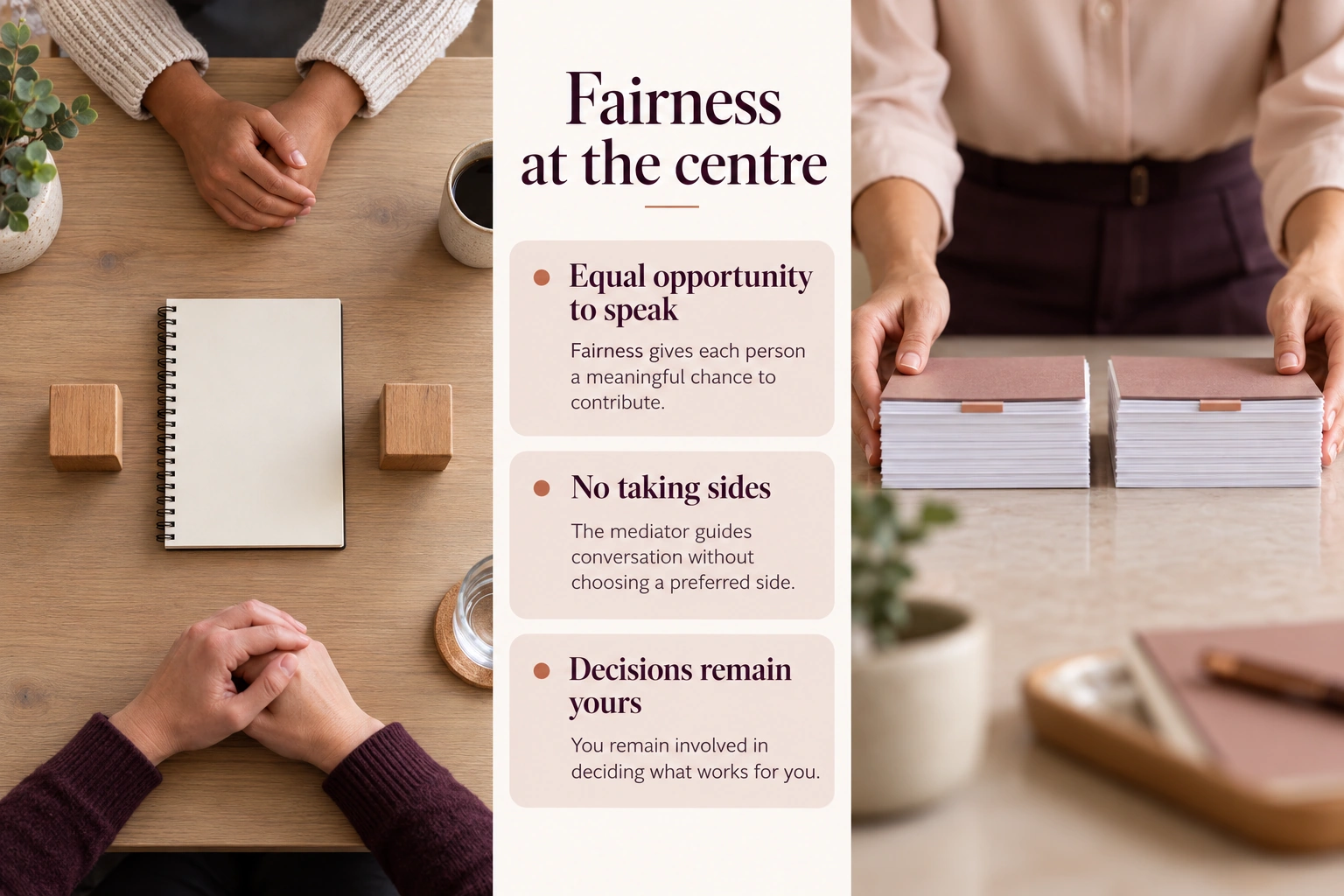
Impartiality is easy to promise and hard to practise. It does not mean saying nothing, and it does not mean treating every suggestion as equally sensible. It means that the mediator's attention is shared evenly, that no one is hurried or talked over, and that the structure of the conversation does not favour the person who is more confident, more articulate or more used to arguing.
In practice this involves a lot of quiet technique. A mediator may ask the quieter person to expand on a point that was nearly missed. They may slow things down when one person is moving faster than the other can follow. They may restate a comment in neutral words, so that the content is heard without the heat that came with it. They may also remind both people that a proposal is not a demand, and that disagreeing with an idea is not the same as rejecting the person who offered it.
Fairness also covers the process itself. Each person is told how mediation works before anything else happens. Each is given the chance to ask questions in private. Nobody is asked to reveal more than they are ready to share, and nobody is asked to sign up to something they do not understand.
Where a situation is so uneven that fair discussion does not seem possible, we would rather say so than carry on regardless. Mediation works well when both people can take part freely. If that is not the case, the right thing to do is to pause and think about what other support might be better.
Listening Before Solving
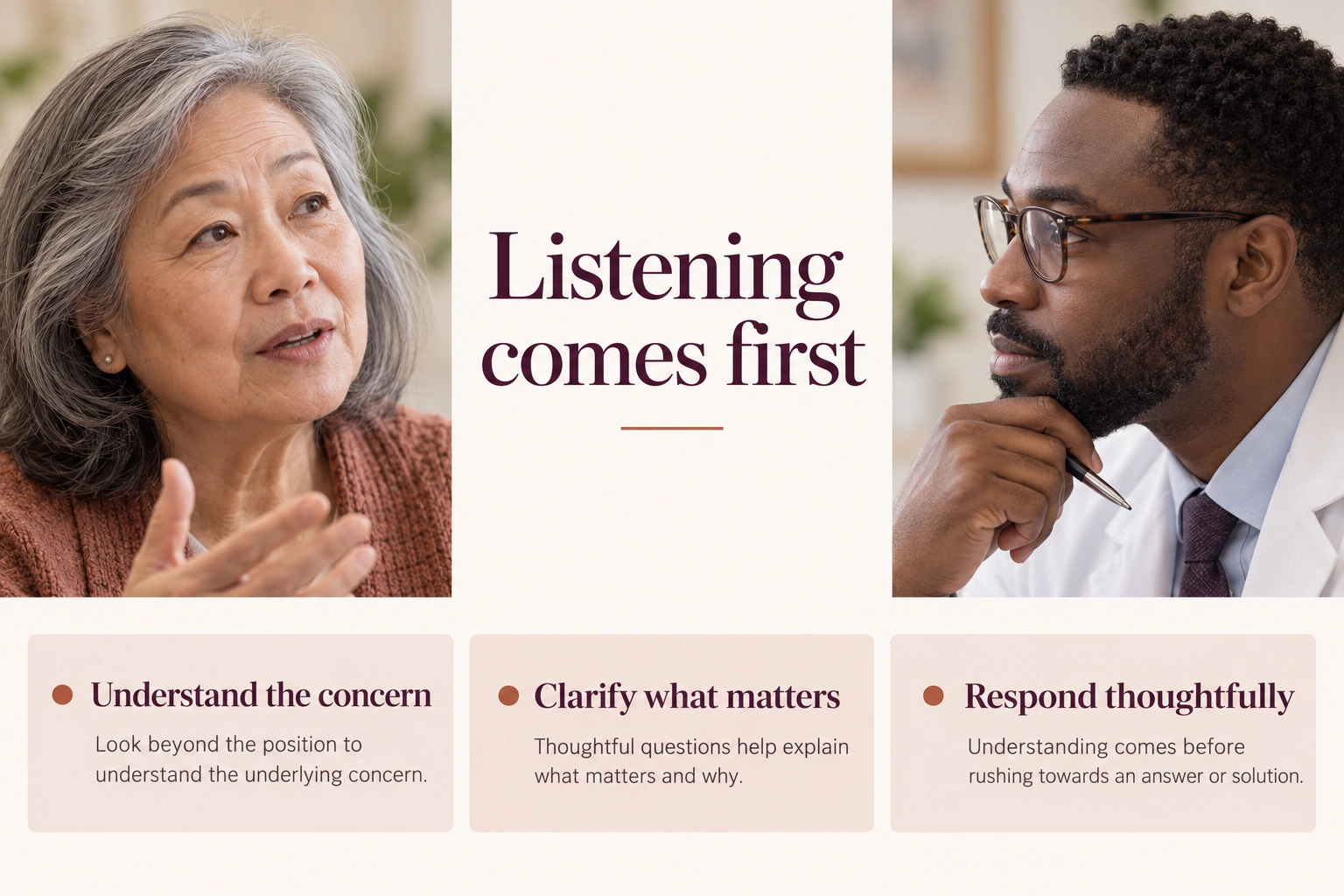
A common mistake in difficult conversations is rushing to the answer. Both people usually already have a solution in mind, and each has often rehearsed it many times. The trouble is that a solution offered before the other person feels heard tends to be rejected on principle, however reasonable it is.
For that reason a mediator spends the early part of the process listening. The aim is to understand what matters to each person and why. Someone who asks for the children every weekend may really be asking for reassurance that they will not become a distant figure. Someone who wants to sell the house quickly may be thinking less about money than about the need for a clean break. Once those underlying concerns are visible, there are often several ways to meet them, and some of them are easier to accept than the original demand.
Listening is also a practical tool. When people feel properly heard, their shoulders drop, their sentences shorten, and the discussion becomes more flexible. It is not a delay before the real work; it is part of the real work.
You can help this along by arriving with an open mind about what the other person might say. You do not have to agree with it. You only have to be willing to hear it long enough for the mediator to check that it has been understood.
Handling Strong Feelings in the Room
Family disputes are rarely only about the topic on the table. Behind a disagreement over a timetable there may be grief, guilt, anger or fear. A mediator does not pretend that these feelings are absent, and does not try to talk people out of them. Instead, the aim is to prevent them from taking over.
There are several practical ways in which this is done. Ground rules are agreed at the start, so that everybody knows what respectful conduct looks like. The mediator may rephrase an accusation into a statement about what the speaker needs. Breaks can be called when tension rises. Sometimes a topic is set aside, and returned to later when both people have had time to settle.
It is perfectly normal to cry, to feel angry or to lose the thread of what you intended to say. None of this is a failure, and nobody will think less of you. What matters is that the conversation continues to be safe and constructive. If it reaches a point where that is no longer possible, the mediator will say so and propose a pause.
People are sometimes surprised that expressing difficult feelings in a structured setting can actually make agreements easier. When feelings have been acknowledged, they have less need to push their way into every discussion.
A Session From the Inside
People often worry most about the unknown, so it helps to describe what a typical session may involve. No two are identical, but the shape is familiar.
Settling in
The mediator welcomes everyone, confirms how long the session will run, and reminds people of the ground rules: take turns, speak for yourself, and keep to the topic being discussed.
Choosing the agenda
Together you decide what needs attention first. Often it is the most urgent matter rather than the largest one. Putting topics in order makes a big situation feel manageable.
Hearing each perspective
Each person has time to explain how things look from where they stand. The mediator may summarise what was said, to check that nothing has been lost or distorted.
Exploring possibilities
Instead of defending positions, you generate options. Some will be set aside quickly. Others will be refined, combined or tested against practical details such as school runs, work patterns and budgets.
Taking stock
Before ending, the mediator reviews what has been discussed and what remains open. You agree what, if anything, each person will think about or find out before the next meeting.
You will not be asked to settle everything in one sitting. Pauses, second thoughts and returning to a topic later are normal parts of the process.
A Pace You Can Manage
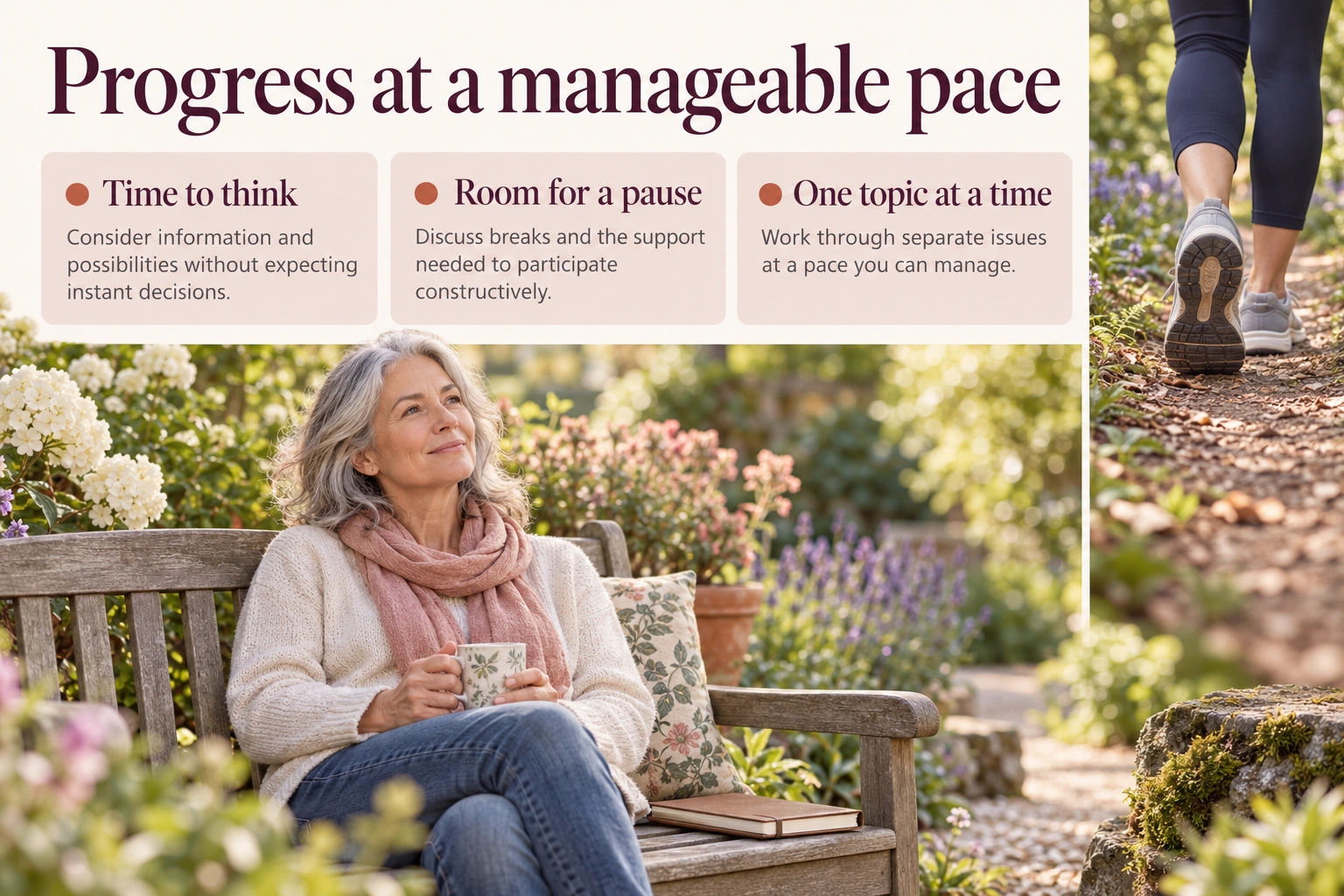
Separation brings an avalanche of decisions, and many people feel pressure to make them all at once. That pressure is understandable, but it rarely produces good outcomes. Decisions taken in a rush are more likely to be revisited, resented or abandoned.
We encourage a steadier rhythm. Urgent matters, such as where the children will sleep this week or how a bill will be paid next month, can be dealt with first. Larger questions can follow once there is some breathing space. Between sessions you have time to reflect, to talk with people you trust and to gather the information that a good decision needs.
Pace also applies within a session. If emotions rise, a short break can help. If a topic is proving too heavy for the day, it can be parked. If one person needs a moment to absorb a proposal, the conversation waits. Moving slowly is not the same as making no progress; very often it is how real progress is made.
Some families want to move briskly, and some need more time. The point is that the speed is chosen deliberately and shared, instead of being dictated by the loudest voice or the nearest deadline.
Turning Conversation Into Something Usable
Good talk is valuable, but decisions need to be remembered and understood in the same way by everyone. That is why mediation moves, where appropriate, from discussion towards a clear written summary of what has been worked out.
A summary typically sets out the topics covered, the points of agreement and any matters that remain open. It is written in plain language and checked with both people for accuracy. The aim is to avoid the all-too-common situation in which two people leave the same conversation with different memories of what was said.
It is important to be clear about the status of such a record. A summary of discussions is a working document that supports your decision-making. Whether any arrangement should be made legally binding, and how, is a question for independent legal advice. We encourage people to consider this before relying on an arrangement for anything significant.
The record is also not the end of the road. Families change, children grow and work patterns shift. A good agreement leaves room to review how things are working, and many people find it reassuring to agree in advance when and how they will revisit their arrangements.
Keeping Children in View

Children rarely sit in the room, yet they are present in almost every decision made there.
When parents separate, the adults tend to be consumed by logistics, emotion and fatigue, while the children are quietly trying to understand what is happening to their world. A mediator keeps returning to one question: what will this arrangement feel like for the child who has to live it?
That question changes the conversation. A schedule that looks fair on paper may mean long journeys, missed friendships or constant packing and unpacking. A plan that suits the adults' diaries may ignore a child's need for a predictable week. By thinking through ordinary days, such as breakfast, homework, bedtime, birthdays and illnesses, parents often find solutions that are kinder and more realistic than their first drafts.
Mediators do not tell parents what to decide, and they do not claim to speak for children. They do help parents agree how to tell their children what is happening, how to keep routines steady, how to handle handovers calmly and how to stay in touch with one another about things that matter to the child, even if they no longer communicate about anything else.
Older children sometimes have strong views of their own. Whether and how those views are heard is a decision for the parents, with the mediator's support, and the aim is always to protect the child from feeling responsible for adult choices.
Formats That Suit Different People
People do not all feel comfortable in the same setting. Offering different ways to take part helps more people to use mediation safely and productively.
Sitting down together
Both people take part in the same conversation, guided by the mediator. This often works well where communication is strained but manageable, because it allows ideas to be tested in real time.
From your own space
Taking part by video or telephone can reduce travel, ease scheduling and let people take part from somewhere familiar. It suits many families who live in different places or who juggle demanding routines.
Separate conversations
Where being in the same space feels too difficult, the mediator can speak to each person separately and carry information between them in a careful, neutral way. This is commonly described as shuttle mediation. It protects people's comfort while still allowing the conversation to move forward.
Choosing a format is part of the first conversation. It can be changed later if something is not working, and nobody has to justify a preference for a particular arrangement.
Money, Housing and Everyday Practicalities
Financial questions can feel more frightening than emotional ones, because they are bound up with security, independence and the future. They are also, in some ways, easier to organise. Numbers can be listed, compared and checked.
In mediation, financial discussions usually begin with building a clear shared picture: what comes in, what goes out, what is owned and what is owed. Having the same facts in front of both people removes a great deal of suspicion, because each can see where the other's concerns come from. From that picture you can talk about priorities, immediate pressures and what a workable arrangement could look like.
Housing is often the hardest topic, because a home is both an asset and a place of belonging. Mediation gives space to explore different possibilities, such as one person remaining in the property, selling and dividing the proceeds, or an interim arrangement while longer-term plans take shape. Each option is looked at in terms of cost, practicality and its effect on any children.
Everyday practicalities are part of this too: who keeps the family car, how shared subscriptions are closed, what happens to joint accounts, how belongings are divided and how future costs for children will be shared. These items sound small, but unresolved they can generate large resentments.
Because financial arrangements can have lasting legal consequences, we encourage people to consider independent legal or financial advice alongside mediation, especially before making any final commitment.
What We Ask of the People We Work With
Mediation is a shared effort, and good outcomes depend on both people bringing something to it. We do not ask for perfection, only for a few simple commitments.
- Honesty. Share information that is relevant to the decisions being made, especially about money and children's routines.
- Courtesy. Listen without interrupting, and speak about the other person in a way you would be comfortable with them overhearing.
- Openness. Be willing to consider ideas you had not thought of, even if you end up rejecting them.
- Follow-through. If you say you will find something out or think something over, try to do so before the next conversation.
In return, you can expect us to be prepared, patient, impartial and clear about what the process can and cannot do.
Using the Advice You Already Have
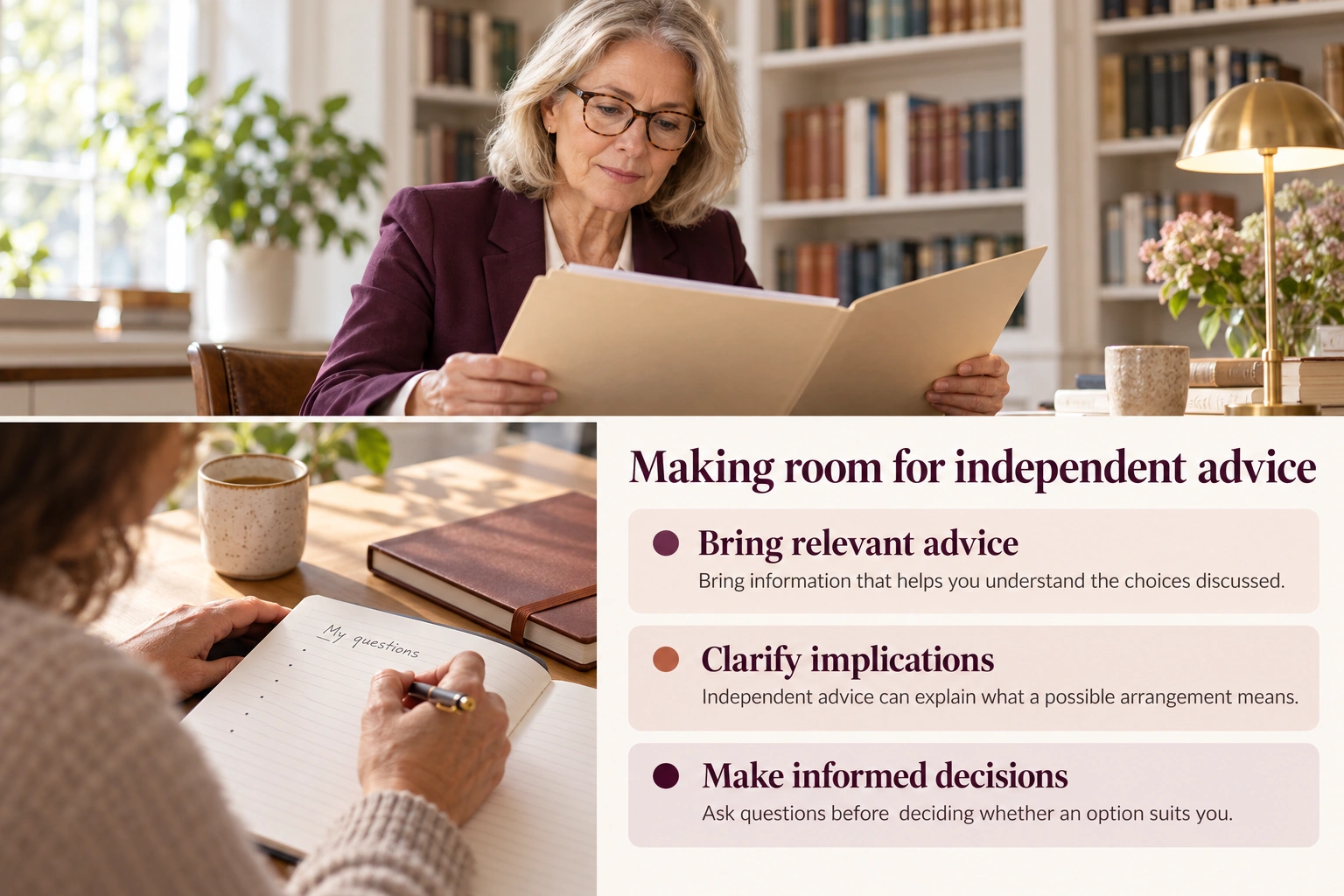
Mediation does not replace solicitors, financial advisers, counsellors or other professionals, and it does not ask you to choose between them and the mediation process. Many people find that the two work well together.
A solicitor can explain your legal position and the likely consequences of different choices. A financial adviser can model what an arrangement means for your long-term position. A counsellor or therapist can help with the emotional weight of what is happening. A mediator contributes something different again: a structured, neutral space in which the two of you can talk with each other, in your own words, about what you would like to happen.
You are welcome to take ideas from mediation to your adviser, and to bring their comments back. Where useful, the mediator can help you think about what questions to ask. What a mediator will not do is give legal advice to either person, because doing so would compromise their impartiality.
If you are not currently working with any adviser, that does not stop you from beginning. You can decide later whether, and when, to seek additional help.
What Mediation Cannot Do
It is better to be clear about the limits of mediation than to promise more than it can deliver.
- Mediation cannot make anyone take part. It works only when both people are willing to try.
- A mediator cannot decide who is right or impose an outcome. Decisions remain with the people involved.
- It is not a substitute for protection where someone is at risk. Safety comes first, and if mediation is not appropriate we will say so.
- It cannot guarantee agreement. Some conversations end without resolution, although many people still leave with clearer information and better understanding.
- An agreement reached in mediation does not automatically carry the same weight as a court order. Where an arrangement needs to be legally binding, independent legal advice about the next step is sensible.
Being honest about these limits is part of treating people with respect. You deserve to make decisions with realistic expectations.
Asked About How We Work
Do we both have to be in the same room?
No. Sessions can be arranged so that you do not sit face to face, and in some cases the mediator speaks with each person separately. The right format depends on what feels safe and workable.
What if we cannot agree on anything?
That is common at the start. Mediation does not require agreement at the outset. It helps people discover whether there is more common ground than it seemed.
Will the mediator tell us what to do?
No. A mediator guides the process, not the outcome. They may ask challenging questions, but the decisions belong to you.
Can I bring someone with me?
Practical arrangements for support people are best discussed by telephone before any meeting, so that everyone understands what is possible and the process stays fair.
Is mediation only about children?
No. People use it for arrangements about children, for financial and housing questions, and for general communication after separation.
How do I know if it is suitable for me?
A first conversation helps you decide. We will talk about your circumstances and be honest about whether mediation seems likely to help.
What if I feel nervous?
Nervousness is normal. Telling the mediator how you feel is useful, because pace, format and breaks can be adjusted.
Does starting mediation commit me to finishing it?
No. You can pause or stop whenever you choose. Taking part is a decision you can review at any point.
Speak with us about your situation
A telephone conversation is an easy first step, with no obligation to continue.